

- Rowing is a full-body workout: around 85 percent of the muscles are involved in every stroke.
- The power comes from about 60 percent from the legs, around 30 percent from the core and back, and only about 10 percent from the arms.
- Primary muscles: quadriceps and glutes, erector spinae and latissimus dorsi, abdominal muscles, plus biceps, shoulders and forearms.
- Because you are seated and do not absorb impacts, rowing is easy on the joints while building endurance and strength at the same time.
- The catch: The technique has to be learned, and a rowing machine needs a permanent place in the room.
Few home fitness machines engage the legs, back, core and arms simultaneously like a rowing machine. Anyone sitting on one for the first time almost always underestimates the same point: rowing is not an arm exercise. This article explains which muscles really work, the order in which they do so, and who can benefit from the effort.
Which muscles does a rowing machine train?
A rowing machine trains practically the entire muscle chain: the legs, glutes, back, abdominals, shoulders and arms work together with every stroke. Rowing organizations such as British Rowing estimate that around 85 percent of the muscles are involved, one of the highest figures among common home workouts. Anyone who otherwise trains their legs and upper body separately works both in one movement when rowing.
To understand exactly which muscles are working, it helps to look at the individual groups.
| Region | Primary muscles | Role in the pull |
|---|---|---|
| Legs | Quadriceps, glutes, calves | The engine: they initiate and drive the pull |
| Back | Latissimus dorsi, erector spinae, trapezius | Transfers the power from the legs and opens the upper body |
| Core | Rectus abdominis and obliques | Stabilizes the body and maintains proper posture |
| Arms and shoulders | Biceps, rear deltoids, forearms | Finally, pull the handle toward your body |
The role of the arms is striking. The muscles that most people immediately think of when they hear the word rowing make up the smallest contribution. Anyone who pulls only with their arms is performing the movement incorrectly and will be exhausted after ten minutes without having achieved much of a workout.
How is force distributed during the rowing stroke?
The force is distributed roughly in a ratio of 60 to 30 to 10: around 60 percent comes from the legs, about 30 percent from the core and back, and roughly 10 percent from the arms. This sequence is also the order of the movement. A proper rowing stroke consists of four phases:
- Starting position: Knees bent, arms extended, upper body slightly leaning forward. Start position.
- Drive phase: push first with your legs, then straighten your back, and finally pull the handle toward your abdomen with your arms.
- Finish: legs extended, elbows behind your body, shoulder blades together.
- Recovery phase: glide back in reverse order: extend your arms, lean your upper body forward, then bend your knees.
The most common beginner mistake is starting with the arms instead of the legs. If you remember the sequence legs, back, arms and reverse it on the way back, you’ve understood the core of the technique.
Is rowing good for endurance and weight loss?
Yes, rowing trains endurance and strength at the same time while burning a substantial number of calories. Because so many large muscle groups are involved, your heart rate rises quickly and energy expenditure is higher than with, for example, easy cycling. As a guideline, many people burn roughly 400 to 600 calories per hour at a moderate pace, depending on body weight, intensity, and technique.
The real advantage lies in the combination. Rowing is cardio and strength training in one: you build endurance while challenging your legs and back. For weight loss, the overall balance between exercise and nutrition is what ultimately counts, but as a calorie burner per minute invested, rowing is hard to beat. Two to three 20- to 30-minute sessions per week are a solid starting point.
Who is rowing suitable for, and who is it not suitable for?
Rowing is suitable for almost anyone who wants to build strength and endurance in a joint-friendly way, because you’re seated and don’t absorb impacts as you do when jogging. That makes it interesting for beginners, people with sensitive knees, and anyone short on time who wants a full-body machine instead of three separate ones.
But let’s be honest: it isn’t ideal for everyone. There are two things you should know beforehand.
- Technique matters. If performed incorrectly, the load ends up in your lower back instead of your legs. Take the first few sessions slowly and focus on good form rather than speed.
- Space and setup. A rowing machine is longer than an exercise bike. In a Swiss rental apartment, that means planning for floor space. Models with transport wheels can at least be stored upright in a corner.
The feedback we hear most often about the water rower is less about workout plans and more about this dual benefit: a machine that challenges your whole body and can still stay in the living room instead of disappearing into the basement.
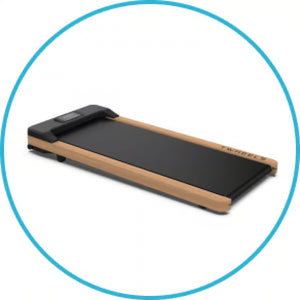
If you simply want to get moving without learning technique, a walking desk with a standing desk and walking pad is often a better choice.
Does the resistance change which muscles are engaged?
The muscles trained remain the same, but the feel and resistance curve change depending on the type of resistance. Whether water, magnetic or air resistance: rowing always engages the same chain of muscles. What differs is how the pull feels and how much the resistance increases with your force.
With water resistance, the pull scales with the force you apply. Pull harder and the water becomes more challenging; pull more gently and it moves more easily. This comes closest to rowing on a lake and feels consistent throughout the movement, with the calm swishing sound of the water on every stroke. We have broken down which type suits whom in detail in our comparison Rowing machine: water, magnetic or air resistance.
What should you look for in a rowing machine for home use?
Pay attention to three things: consistent resistance, a sturdy construction suited to your height and weight, and space-saving storage. The material is worth a second look, because a rowing machine is rarely kept out of sight.
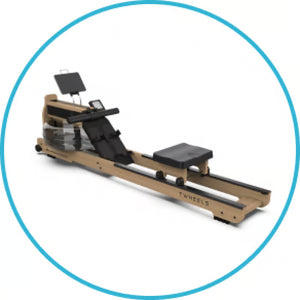
Here is an example from our own range to put the figures into perspective: Our oak water rower is made from solid Canadian oak, designed for rowers up to 200 cm tall and weighing up to 180 kg, with water resistance and an LCD display for distance, time, heart rate and calories. Bluetooth and the Kinomap app let you row real routes. For storage, stand it upright and roll it against the wall on its transport wheels. If you want to keep the water tank clean over the long term, add one chlorine care tablet every four to five months to prevent limescale, algae and deposits.
Solid wood is not merely a decorative feature, but a question of longevity and whether the equipment can remain in your living space. Find out more in our overview of wooden fitness equipment for the living room or browse the TWHEELS fitness equipment selection directly.
Frequently asked questions
Does rowing also train the abs?
Yes. The abdominal muscles work as stabilizers during every stroke, ensuring that power is transferred cleanly from the legs to the upper body. Visible abs mainly result from a low body-fat percentage, but rowing trains the core continuously.
Does a rowing machine build muscle, or is it just cardio?
Both, with an emphasis on endurance and muscular endurance. For substantial muscle growth like that achieved through targeted strength training, the resistance is usually too low, but the legs, back and core become noticeably stronger and more defined, especially for beginners.
How often should I row?
For beginners, two to three sessions per week lasting 20 to 30 minutes are enough. At first, proper technique is more important than duration. It is better to row for less time with correct form than for longer with a rounded back.
Is rowing bad for your back?
When performed correctly, rowing strengthens the back rather than harming it. It becomes problematic with incorrect technique, such as pulling with a rounded back or initiating the movement with the arms instead of the legs. If you want to be on the safe side, start with low resistance and focus on your posture.
How loud is a water rower?
A water rower mainly produces a rhythmic swishing sound from the water, not loud mechanical noises. It is usually not a problem in a rented apartment; during normal use, it is no louder than a regular conversation.
Which muscles are most involved when rowing?
The thigh muscles and glutes, because the drive comes from the legs. Next are the spinal erectors and latissimus dorsi, which transfer the power. The arms contribute only about one tenth.
Our conclusion
A rowing machine is one of the most efficient home fitness machines because a single movement trains almost the entire body: from the legs as the driving force, through the back and core, to the arms at the end of the stroke. It builds endurance and strength at the same time, is easy on the joints and burns a substantial number of calories. The trade-off is learning the technique at the beginning and finding enough space in the room. If you plan for these two points, you get a workout that covers more than most individual machines.
If you're looking for a rowing machine that challenges your whole body while still looking at home in your living room, take a look at the TWHEELS solid oak water rower: solid Canadian oak, water resistance and Kinomap connectivity, designed for users up to 200 cm tall and weighing up to 180 kg.