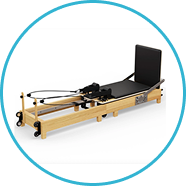


A TWHEELS Pilates Reformer measures 247 x 67 x 40 cm and weighs 77 kg. The machine footprint alone is 1.65 m². For training, we recommend keeping a 3.5 x 2.0 m area permanently clear, or around 7 m². Foldable does not mean small: plan based on the assembled dimensions, not on hope.
- Manufacturer’s specifications: 247 x 67 x 40 cm, 77 kg, load capacity up to 204 kg.
- Our recommendation for the training area: keep 3.5 x 2.0 m permanently clear.
- Ceiling height: your height plus a 40 cm frame plus some reserve. In a 2.10 m basement, even someone 1.70 m tall will hit the ceiling.
- The delivery arrives on a pallet to your doorstep, not on the second floor.
- If you do not have the space permanently available, mat Pilates is the more honest choice.
Contents
- How much space does a Pilates Reformer really need?
- How do I calculate my space requirements specifically?
- How much difference does the folding mechanism really make?
- What ceiling height does a reformer need?
- What do 77 kg mean for parquet, older buildings, and impact noise?
- Which room does the Reformer work in, and which does it not?
- How does the Reformer get into the apartment in the first place?
- Frequently asked questions
- Our conclusion
How much space does a Pilates Reformer really need?
Three dimensions matter, not one: machine footprint, usable area, and manoeuvring area. Only the machine footprint is included in the specifications, and that is exactly where most home-planning calculations fail.
The maple wood Pilates Reformer measures 247 x 67 x 40 cm and weighs 77 kg, with a load capacity of 204 kg. These are the manufacturer’s specifications. All additional clearances mentioned from this point onwards are our recommendations based on setup and training, not manufacturer specifications.
The mistake is always the same: you measure the machine, find 2.47 metres along a wall, and consider the matter settled. But on the Reformer, you do not lie still. Your arms move overhead, your legs extend into the springs, and you get on and off from the side. The required area is significantly larger than the machine.
How do I calculate my space requirements specifically?
Take a tape measure, not a guess: machine dimensions, plus 60 cm on each long side, plus 80 cm at the head end. These additional clearances are our recommendation, not part of the specification.
- Width: The 67 cm machine plus 60 cm on the left and 60 cm on the right gives 187 cm. You need one side for getting on and off, and the other for your arms and ropes.
- Length: The 247 cm machine plus 80 cm at the head end gives 327 cm. That is where you stand while setting it up, reach for the ropes, and place the box and Jump Board.
- Practical dimensions: 327 x 187 cm equals 6.11 m². Since nobody clears space to the exact centimetre, we recommend rounding up to 350 x 200 cm, or 7.0 m².
- Check: Tape out 350 x 200 cm on the floor with painter’s tape and leave it there for three days. If something lands inside it three times during those three days, you have your answer.
| Dimensions | What for | Length x width | Area | Source |
|---|---|---|---|---|
| Equipment footprint | The Reformer itself, assembled | 247 x 67 cm | 1.65 m² | Manufacturer specification |
| Usable space | Arms and legs extended; space to get on and off from the side | 327 x 187 cm | 6.11 m² | our recommendation |
| Maneuvering space | Turning, folding, and storing the Box and Jump Board | plus 100 x 67 cm at one short end | 0.67 m² | our recommendation |
| Our recommendation | What should remain permanently clear | 350 x 200 cm | 7.0 m² | our recommendation |
One figure is deliberately missing from the table: the turning radius. A 247 cm-long piece of equipment cannot be turned around in a 200 cm-wide room. It will then remain parallel to the wall where it was placed. Measure the longest clear diagonal beforehand.
How much difference does the folding mechanism really make?
The folding mechanism makes the equipment smaller, but not lighter. 77 kg remains 77 kg. The specification lists exactly one dimension: 247 x 67 x 40 cm when assembled. We do not publish a folded dimension, and we will not invent one here.
In practical terms, plan around the assembled dimensions. Folding helps for the one evening when guests come over, but not as a daily routine. Anyone who moves 77 kg every day will do so for two weeks, after which the equipment will remain assembled—or not be used at all.
Folding it is straightforward: customers describe simply pulling the safety pin while the frame remains under control instead of falling into its end position. A safety detail, not a space-saving feature. If you are looking for equipment that truly disappears, it is better to look first at the space-saving fitness equipment. And two items are forgotten in every space calculation: the Reformer Box and Jump Board are included, both are bulky, and both need to be stored somewhere.
What ceiling height does a reformer need?
Ceiling height becomes relevant as soon as someone stands on the equipment. The frame is 40 cm high, so anyone standing on the footbar or carriage is 40 cm higher than usual.
Our rule of thumb, explicitly a recommendation rather than a manufacturer specification: body height plus 40 cm for the equipment height plus 15 cm of clearance for an upright posture and raised arms. At a height of 1.70 m, that is 2.25 m; at 1.80 m, it is 2.35 m; at 1.90 m, already 2.45 m.
In a standard living room, this is not an issue. It becomes critical in two places: in the basement, where pipes and conduits run beneath the ceiling, and in the attic, where the sloping roof reduces the height exactly where there would otherwise be free space. In the basement, do not measure in the middle of the room; measure at the planned installation area and allow for the lowest pipe or conduit.
What do 77 kg mean for parquet, older buildings, and impact noise?
Structurally, the Reformer is not a problem for a normal apartment, but it can be a problem for the flooring. The 77 kg are not distributed across a large surface; they rest on the small rollers and frame supports. On soft parquet, vinyl, or linoleum, this can leave marks over time.
In a rented apartment, that can ultimately cost you your security deposit, so use felt under the contact points. A note that matters more to us than an upsell: Our floor-protection mat measures 226 x 90 cm, making it 21 cm shorter than the Reformer. It does not cover it completely.
Impact noise is usually overestimated with a Reformer. You do not walk on it, and it has no motor. What is transmitted is the carriage hitting the end of the rail, which is audible in older buildings with wooden beam ceilings. A mat dampens this within the room, but it does not replace impact-noise insulation for the apartment below. If you train at seven in the morning, it is better to slow the final few centimetres down yourself.
Which room does the Reformer work in, and which does it not?
The living room wins almost every time because it combines sufficient floor space and ceiling height. The basement loses most often—not because of the available space, but because of the route to get there.
| Room | Floor area 350 x 200 cm | Ceiling height | Verdict |
|---|---|---|---|
| Bedroom | Length is often available, but the bed is in the way | Generally unproblematic | Works if one side of the wall remains permanently clear |
| Living room | Usually the most realistic space | Uncritical | Best choice if it can remain visibly in place |
| Screed or attic | Space is often available | The sloping ceiling is the problem | Only if the 3.5 m are beneath the higher section |
| Basement | Usually enough space, tight access | often lower than on the residential floor; be sure to measure it yourself here | Critical: measure the stairs and conduits first |
A point against our own sales logic: If you can only get these 7 m² by removing the dining table, you are buying the wrong piece of equipment. Our article on the Pilates Reformer for home use will help you determine whether mat Pilates is enough for you. If you generally have to plan with very little floor space, the fitness equipment for small apartments offers more honest alternatives.
How does the Reformer get into the apartment in the first place?
On a pallet, up to the delivery address, not to the second floor. This is the part of the space requirement that no tape-measure calculation covers, and the part we receive the most criticism about.
«Ordered on the 10th, delivery was announced for Tuesday, but it arrived on Thursday evening just before eight without any prior notice. The driver left the pallet in front of the garage and drove away; I was left alone with the full weight. One corner was dented and the headrest had a crack. Support immediately sent a replacement and was genuinely decent, but I am still absolutely furious with the shipping company.»
Goran Bär, 1 star, verified purchase
This review is displayed exactly as submitted and will remain. The fact that support immediately sent a replacement does not change that someone was standing alone in front of a pallet at eight in the evening. It answers the most important planning question: Arrange for a second person on the delivery day. Not optional.
These are the three measurements you need to check before ordering, not afterwards:
- Doors: The equipment is 67 cm wide. Measure every doorway at its clear width, between the frames, and allow for the packaging and your fingers.
- Stair landing: Measure the longest diagonal. If it is shorter than 247 cm, the package will not make it around the corner, no matter how strong you are.
- Lift: Measure the inside diagonal and check whether the lift door can accommodate a 247 cm-long box. Usually, it cannot.
And the point that dominates every calculation: The customer bears the return shipping costs, and at 77 kg on a pallet, they are no small expense. If you are unsure, view the equipment at the Weesen warehouse or collect it there. Everything else you need to know before ordering is in the guide Buying a Pilates Reformer.
Frequently asked questions
How many square metres does a Pilates reformer need?
The equipment itself takes up 1.65 m² (247 x 67 cm). For training, we recommend keeping an area measuring 350 x 200 cm permanently clear, or 7.0 m². This area is our recommendation, not a manufacturer specification. It consists of the equipment dimensions plus 60 cm on each long side and 80 cm at the head end, rounded up to a practical size.
Will a reformer fit in the bedroom?
Often yes, but only if an entire side of a wall remains permanently clear. The critical factor is not the room size but the longest uninterrupted clear stretch: you need 327 cm in length and 187 cm in width. A bed that extends into this area makes getting on and off from the side impossible.
How much space does folding it up really save?
Less than the term “foldable” might suggest. The specifications list only one measurement, 247 x 67 x 40 cm when assembled; we do not publish a separate folded size. The weight remains 77 kg. Foldability helps when you have guests over for an evening, not as part of a daily storage routine.
What ceiling height do I need for a Reformer?
Our recommendation: your height plus 40 cm for the frame height plus 15 cm of clearance. At 1.70 m, that's 2.25 m; at 1.80 m, 2.35 m. In normal living spaces, this isn't an issue. In a basement with pipes under the ceiling or in an attic with a sloping roof, space quickly becomes tight—measure at the planned installation area.
Can I move the Reformer by myself?
You can turn it briefly on its own axis, but regularly pushing it sideways across the apartment isn't practical. At 77 kg, with small wheels, it's not a one-person job on carpet or over door thresholds. So plan for the equipment as a piece of furniture that stays in place, not as a piece of exercise equipment that disappears into a cupboard.
Will the Reformer be delivered inside my home?
No. The Reformer arrives on a pallet at the delivery address, not inside your home and not on the second floor. Arrange for a second person on the delivery day and measure the doors, stair landings, and elevator beforehand. Alternatively, you can pick up the equipment at the Weesen warehouse and inspect it there first.
What should I do if I don't have enough space after all?
Be honest with yourself and don't order. At 77 kg on a pallet, the customer bears the return shipping costs, which gets expensive for bulky goods. Mat Pilates requires significantly less space—essentially the mat's length plus arm's reach—and is the better choice as long as 7 m² isn't permanently available. The Reformer isn't going anywhere.
Our conclusion
The only number that really matters is the space you can keep permanently clear: 350 x 200 cm according to our recommendation, not 247 x 67 cm according to the datasheet. If you have that space, you get a studio-quality machine for your living room. If you only have it by rearranging furniture, you'd be better off sticking with the mat. And if you order, plan for the delivery day with a second person.
If you have 350 x 200 cm available: The maple wood Pilates Reformer ships from our warehouse in Switzerland, with a Reformer Box and Jump Board, 5 color-coded steel springs, and a 2-year warranty. If you have questions about the transport route, contact info@twheels.ch or +41 43 508 20 26 beforehand—that's cheaper than a return.
About the author: Lena Brunner writes and tests for TWHEELS. For this article, she calculated the space requirements based on the verified equipment dimensions, recalculated each total individually, and explicitly separated the recommended clearances from the manufacturer's specifications. Learn more on the author page.