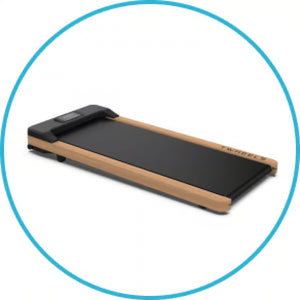


- “Treadmill for home” refers to three very different devices: the flat Walking Pad for walking, the classic motorized treadmill for jogging, and the motorless Curved treadmill for sprinting.
- The decision does not come down to price, but to one question: Do you want to walk, run, or sprint? If you confuse them, you will buy the wrong product for your needs.
- Space is the decisive filter. A Walking Pad has a running surface measuring 107 x 41 cm and disappears under the sofa. A Curved treadmill measures 200 x 70 x 110 cm and stays in place.
- In a rented apartment, noise matters more than any app. Our Walking Pad operates at around 45 dB, which is room-volume level.
- Our price range in Switzerland: from CHF 399 for the Walking Pad, CHF 1'849 for the motorless Curved treadmill.
Contents
- What types of treadmills are available for home use?
- The three designs compared directly
- Which treadmill suits your goal?
- How much space does a treadmill really need?
- How loud is a treadmill in a rental apartment?
- What should you look for when buying?
- How much does a good treadmill cost in Switzerland?
- The three most common bad purchases
- Frequently asked questions
- Conclusion: your decision shortcut
“I want a treadmill for home” is how most bad purchases begin. Not because the wish is wrong, but because three completely different devices share the same name. Anyone setting out with a studio treadmill in mind ends up with a device that takes up half the living room, even though they really only wanted to walk while working. And anyone who saves money on a Walking Pad gets annoyed when they realize that jogging on it is not possible.
What types of treadmills are available for home use?
Three designs that differ fundamentally in their drive systems, speed, and space requirements. They solve three different problems, and none of them is “the best.”
- The Walking Pad is a flat, motorized walking and running treadmill without a handrail. It typically runs at up to 6 km/h, or up to 12 km/h with a handlebar, and is designed to sit under a desk or in front of the sofa and then be put away.
- The classic motorized treadmill is the device most people have in mind: a fixed handrail, a large display, speed adjustment at the touch of a button up to around 20 to 24 km/h, and often electric incline for hill training. It requires a permanent spot and a power connection.
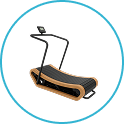
- The Curved treadmill has no motor. The curved running surface moves only when you run, so there is no upper speed limit. It is designed for sprints and intervals, not leisurely walking.
The most important point for your decision: A Walking Pad is a piece of furniture that helps counter excessive sitting, a motorized treadmill is a fitness machine for endurance, and a Curved treadmill is a sports machine for intensity.
The three designs compared directly
The table shows how they differ. The highlighted column is the one that suits most people at home because it is used daily rather than once a week.
| Criterion | Walking Pad (our recommendation for most people) | Classic motorized treadmill | Curved treadmill (motorless) |
|---|---|---|---|
| What each one is designed for | Walk while working, take steps throughout the day | Jogging, endurance running, hill training with incline | Sprints, intervals, HIIT |
| Speed | Up to 6 km/h, or up to 12 km/h with the handrail | Usually up to 20 to 24 km/h, adjustable at the touch of a button | No limit; you set the pace with your legs |
| Incline | None | Often electrically adjustable | None; the curve partially replaces it |
| Space | Flat, transport wheels, fits under a sofa or bed | Permanent location, many models fold vertically | Permanent location, 200 x 70 x 110 cm, around 80 kg |
| Power | Power outlet required, low consumption | Continuously connected to the mains | None |
| Noise level | Around 45 dB at walking speed, suitable for calls | Clearly audible when running: motor plus footsteps | No motor hum, but belt and sprinting strides |
| Getting started | Very easy: step on and go | Beginner-friendly, preset speed | Challenging from the first minute |
| Our price | CHF 399 (6 km/h) or CHF 499 (12 km/h + handrail) | Coming soon to our range | CHF 1,849 |
Which treadmill suits your goal?
Answer one question honestly: What will you really do with it in everyday life—not what do you intend to do?
- You sit a lot for work and want to move more. Then the Walking Pad is the answer. 2 to 3 km/h is enough to type and make phone calls at the same time, adding several thousand steps over the course of a working day that would otherwise simply be missing.
- You want to jog regularly, regardless of the weather or time of day. Then you need a full-size treadmill with a handrail, higher speeds and ideally an incline. A walking pad will disappoint you here.
- You have a basic level of fitness and want intensity. Then the motorless curved treadmill is worth considering. It has no speed limit and makes every workout more demanding because you power the belt yourself.
- To be honest, you want both: quiet walking during the workday and the occasional proper run. That means two pieces of equipment or a conscious compromise. The 12 km/h version of our Walking Pad is precisely that compromise: raise the handrail for brisk walking and light jogging, or fold it flat for walking under a standing desk.
A safety note we deliberately do not put in small print: With the handrail folded down, you should only walk at up to 6 km/h. From around 8 km/h, the bar is not a comfort feature but a safety feature.
How much space does a treadmill really need?
More than the product photos suggest—and this is exactly where most home gym plans fail. Measure up before ordering, and add space for movement to the equipment’s dimensions alone.
Specifically for our equipment: The oak Walking Pad has a running surface measuring 107 x 41 cm and is flat enough to disappear under a sofa or bed on its transport wheels. The Sprinting Machine measures 200 x 70 x 110 cm and weighs around 80 kg net. This is not a piece of equipment you put away in the evening; it gets a permanent place and stays there.
Two points that are easy to forget. First, the ceiling height: On a treadmill, you stand several centimetres higher than on the floor, and in older buildings with sloping ceilings, that can quickly become a problem. Second, the floor underneath. An 80 kg machine can leave pressure marks on parquet flooring, so a floor protection mat costing CHF 89 isn't an optional extra here; it's part of the calculation.
How loud is a treadmill in a rental apartment?
Quieter than most people fear, but impact noise is the real issue. Our Walking Pad measures around 45 dB at walking speed, roughly equivalent to a quiet conversation in the next room. You can easily sit in a video call without anyone asking what's going on.
What the neighbours hear is rarely the motor, but rather your footsteps travelling down through the floor. A cushioned running surface absorbs the impact, while a mat underneath isolates the rest. Even so, jogging—and especially sprinting—still creates noticeable kinetic energy. If you live in a poorly insulated Swiss rental apartment and are honest with yourself, intensive training probably isn't something to schedule for 10 p.m. We've written down what it actually sounds like in detail here: How loud is a Walking Pad really?
What should you look for when buying?
These six points determine whether the equipment will still be running in six months or end up as an expensive coat rack. In this order:
- Speed range: Is walking up to 6 km/h enough, or do you want to run? From around 8 km/h, you need a handrail; that's not a matter of personal preference.
- Weight capacity: It says more about the build quality than about your weight. A frame that supports 135 kg is also less likely to wobble at 75 kg. Our Walking Pad is designed for 135 kg, while the Sprinting Machine is designed for 150 kg.
- Running surface: A width of 41 cm is comfortable for walking. If you jog, you'll want more because your stride becomes wider and less steady.
- Cushioning: A cushioned running surface is kinder to your knees and your neighbours at the same time. A hard platform does neither.
- Storage: If you can't put it away, you need to have a permanent place for it. Be honest with yourself here, or it will end up in the way.
- Material and appearance: It sounds like a minor detail, but it determines how much you use the equipment. A solid wood machine can stay in the living room; black plastic gets hidden away, and anything hidden away gets used less often.
What we deliberately don't rank near the top is app connectivity. Bluetooth and Kinomap are included with our Walking Pad and are useful if you want to follow routes. They aren't a reason to buy. Honestly, being able to adjust the speed in 0.1 km/h increments is more useful in everyday life, because you can find exactly the pace at which the text on your screen doesn't wobble while you're typing.
How much does a good treadmill cost in Switzerland?
Our prices start at CHF 399, with a wide range at the upper end. More important than the absolute figure is what determines the price: frame material, cushioning, weight capacity and motor quality. A very cheap machine cuts costs in exactly those areas—and you notice it as soon as you pick up the pace.
- Walking Pad up to 6 km/h: CHF 399. The simplest way to get started with more everyday movement.
- Walking Pad up to 12 km/h with handrail: CHF 499. The compromise for walking plus easy jogging.
- Ergonomics bundle with 140 × 80 cm standing desk: CHF 655, cheaper than buying both items separately.
- Curved treadmill, non-motorised: CHF 1'849. A specialised machine for sprints, with no electricity and no sensitive motor electronics.
With heavier equipment, factor in two items that are often forgotten: the floor protection mat and assembly. For the Sprinting Machine, we offer assembly at your home for CHF 200. At 80 kg, that’s no luxury if there’s no one to lend a hand.
The three most common bad purchases
Based on what we actually encounter in support—not theory:
- Having the gym treadmill in mind. Many people automatically picture the large machine with handrails when they hear “treadmill” and dismiss the idea because they don’t have the space. A flat Walking Pad would have been exactly the right choice.
- Buying more speed than you need. The 12 km/h version looks more sensible on paper, but many people never use it above 5 km/h. If you know you’ll only be walking, save the 100 francs.
- Forgetting about the floor. You order the equipment but not a mat, and suddenly it’s sitting on your brand-new parquet floor. That’s more annoying in hindsight than any difference in features.
Frequently asked questions
Can I jog on a Walking Pad?
Only to a limited extent. The flat models without a handrail are designed purely for walking. The version with a handrail and speeds of up to 12 km/h allows easy jogging, but it isn’t built for regular running training. Anyone who jogs seriously needs a full-size treadmill.
Which treadmill is right for a small flat?
Almost always, a Walking Pad. It’s flat, has transport wheels and disappears under the sofa or bed after your workout. A curved treadmill measuring 200 × 70 cm and weighing 80 kg, on the other hand, needs a permanent spot—something small flats rarely have.
Do I need an incline on a treadmill?
Only if you specifically want to increase endurance and calorie burn. For walking while working from home, incline is irrelevant; it’s about movement time, not intensity. That’s why Walking Pads are deliberately built flat—not as a drawback, but as a prerequisite for storage.
How much can I weigh to use a treadmill?
Pay attention to the specified weight capacity and take it seriously. Our Walking Pad is designed for up to 135 kg, while the Sprinting Machine supports up to 150 kg. A higher weight capacity usually also means a more stable, quieter frame, including for lighter users.
Is a motorless treadmill better than a motorized treadmill?
It is not better, just different. A curved treadmill is more intense because you are the drive yourself, and it has no speed limit. In return, it is more expensive, heavier and demanding for beginners. For steady jogging at a set pace, a motorized treadmill is the more convenient choice.
How much electricity does a treadmill use at home?
A Walking Pad used at walking pace consumes about as much power as a larger household appliance and barely shows up on your electricity bill. A curved treadmill uses no electricity at all because it has no motor. With conventional motorized treadmills, consumption depends heavily on speed and incline.
Is combining it with a standing desk worthwhile?
For a home office, it is the real point of the whole setup. Only together do they create the switch between sitting, standing and walking. A Walking Pad without a suitable desk often becomes a clothes rack after just a few weeks. You can find details in our guide to setting up a walking desk.
Conclusion: your decision shortcut
If you sit too much and want to bring movement into your workday, get a Walking Pad. It is quiet, disappears after use and lowers the barrier to the point where you use it every day. That is where its value lies, not in peak specifications.
If you want to run properly at home, you need a full-size treadmill with a handrail and a permanent place for it. And if you want to sprint and push yourself to your limit, the motorless curved treadmill is the most honest piece of equipment for the job. We go into more detail here: Walking Pad vs. treadmill: a direct comparison and What a curved treadmill really offers.
For most people reading this article, the oak Walking Pad is the right first step: from CHF 399, supports up to 135 kg, runs at around 45 dB and looks good enough to leave out.
“For years, I had this image in my head of some huge machine with handrails, like the ones at the gym back then, and that’s exactly why I never ordered one. I had it completely wrong. I unpacked it in ten minutes and started walking—that’s a completely different experience from what I had imagined.”
Susanne Lüthi, ★★★★★ about the Walking Pad
About the author: Lena Brunner is an editor and tester at TWHEELS. The dimensions, weights and prices mentioned here are based on our own product data as of 5 August 2026. We use the devices described in our own home offices and at our locations in Zurich and Weesen. Learn more about Lena and our testing process on the author page.